








3 Conversation Area Layout Templates for Small Patios

Introduction
Creating a functional outdoor living space becomes challenging when you have limited square footage to work with. A small patio does not mean you have to sacrifice comfort or style, but it does require thoughtful planning before you purchase any furniture.
A conversation area is a seating arrangement specifically designed for relaxation and socializing, typically featuring comfortable chairs or a loveseat grouped around a coffee table or side table. Unlike dining sets built for meals, conversation sets prioritize comfort and face-to-face interaction.
Many homeowners make common mistakes when arranging furniture on small patios. They overcrowd the space with too many pieces, ignore traffic flow patterns, or choose furniture that is too large for the area. These errors result in a cramped, uncomfortable outdoor space that nobody wants to use.
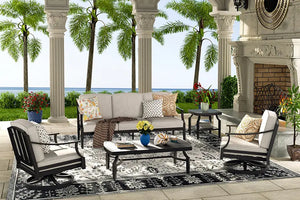
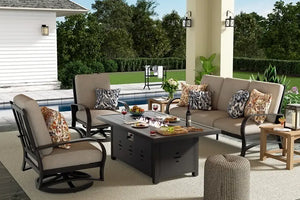
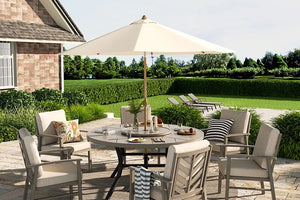
This guide introduces three proven layout templates that work beautifully on small patios. Each template addresses different patio shapes and uses, helping you maximize every square foot. When paired with the right patio conversation set, these layouts transform even the smallest outdoor space into a welcoming retreat.
What Is a Patio Conversation Area and Why Does Layout Matter?
A patio conversation area serves as an outdoor living room designed specifically for relaxation, socializing, and casual gatherings with family and friends.
A conversation area differs fundamentally from a dining area. While dining sets feature tall tables and upright chairs for eating meals, conversation sets include deep-seated chairs, loveseats, or sofas arranged around a low coffee table or side table. The lower seating height and angled positioning encourage comfortable, extended conversations.
The primary function of a conversation area is creating a space where people naturally want to sit, talk, and relax. Whether you are enjoying morning coffee alone, hosting a few friends for drinks, or spending quiet evenings with family, a well-designed conversation area makes your patio feel like a true extension of your home.
- Layout importance for small spaces: On a small patio, layout directly impacts three critical factors. First, proper arrangement ensures adequate traffic flow so people can move around without bumping into furniture. Second, strategic placement creates visual spaciousness, making a compact area feel larger than it actually is. Third, thoughtful positioning maximizes functionality, ensuring every piece serves a purpose without wasting precious square footage.
- Key difference from dining sets: Conversation sets typically sit lower to the ground and feature deeper cushions for lounging. The furniture faces inward toward a central point rather than toward a table for eating. This inward-facing arrangement naturally encourages eye contact and conversation among guests.
How Do You Measure Your Small Patio for a Conversation Set Layout?
The following are five steps to measure your small patio for a conversation set layout:
- Step one — Measure the perimeter: Use a tape measure to record the length and width of your patio in feet. Write down these dimensions immediately. Note any irregular shapes, angles, or cutouts that affect usable space.
- Step two — Identify fixed obstacles: Mark the location of doors, windows, steps, railings, posts, planters, or any permanent fixtures. These elements cannot move, so your furniture must work around them.
- Step three — Calculate total square footage: Multiply your patio length by width. For example, an 8-foot by 10-foot patio equals 80 square feet. A small patio typically ranges from 48 to 120 square feet, which translates to dimensions between 6 by 8 feet and 10 by 12 feet.
- Step four — Reserve space for traffic flow: Subtract clearance areas from your total square footage. You need a minimum of 24 inches for low-traffic walkways and 30 to 36 inches for main pathways where people frequently pass. Doorways require at least 36 inches of clear space for comfortable entry and exit.
- Step five — Note sun and shade patterns: Observe your patio throughout the day. Identify which areas receive direct sunlight during morning, afternoon, and evening hours. Position seating where comfort levels match your primary usage times. If you typically relax in the evening, choose a spot that offers shade during those hours.
What Are the 3 Best Conversation Area Layout Templates for Small Patios?
Three distinct layout templates address the most common small patio shapes and maximize available space effectively.
- Template overview: The Corner L-Shape Layout works best for rectangular patios. The Centered Circle Layout suits square patios perfectly. The Wall-Hugging Linear Layout maximizes narrow patios and balconies. Each template serves different spatial needs while creating comfortable conversation areas.
Template 1 — The Corner L-Shape Layout (Best for Rectangular Patios)
The Corner L-Shape Layout positions furniture along two adjacent walls, forming an L-shaped seating arrangement that opens up the center of your patio.
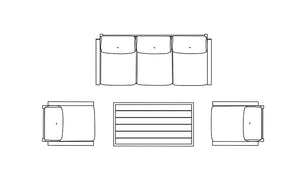
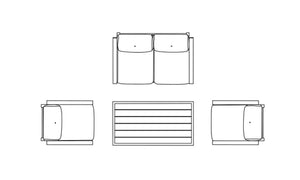
- Visual concept: Picture a loveseat placed along one wall with one or two chairs positioned perpendicular along the adjacent wall. A coffee table or side table sits at the intersection point where the two seating lines meet.
- Best conversation set types: This layout works excellently with 3-piece or 4-piece sets that include a loveseat or small sofa paired with one or two club chairs. Sets featuring swivel chairs add flexibility, allowing guests to turn and face different directions.
- Furniture placement guide: Position your longest piece, typically the loveseat, against the longer wall. Place chairs at a 90-degree angle along the shorter adjacent wall. Angle chairs slightly inward toward the center to promote conversation.
- Coffee table positioning: Place a round or oval coffee table at the corner intersection point where the loveseat and chairs meet. This position allows everyone easy reach to the table surface while maintaining open floor space in the remaining area.
- Advantages: This layout maximizes corner space that often goes unused. It opens the center of the patio for walking or additional activities. The arrangement naturally creates an intimate conversation zone while leaving clear sightlines across the space.
- Limitations: This template requires a true corner with two adjacent walls or boundaries. It works less effectively on patios with only one defined edge or completely open spaces.
- Recommended sets: The Chamber Collection offers excellent options for this layout, including 3-piece and 4-piece aluminum conversation sets with Sunbrella cushions that resist weather while providing lasting comfort.
Template 2 — The Centered Circle Layout (Best for Square Patios)
The Centered Circle Layout positions furniture in a circular or semi-circular arrangement around a central focal point, creating equal conversation access for all seated guests.
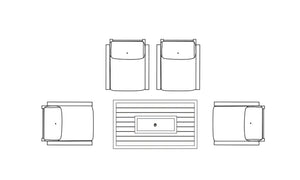
- Visual concept: Imagine four chairs arranged in a circle around a round coffee table, or a loveseat paired with two chairs forming a U-shape around a central table. All seats face inward toward the middle.
- Best conversation set types: This layout pairs perfectly with 4-piece or 5-piece sets featuring symmetrical seating options. Four matching club chairs work beautifully, as do sets combining a small sofa with two or three chairs.
- Furniture placement guide: Position seats at equal distances from the center point, like numbers on a clock face. Leave approximately 18 inches between each seat and the coffee table. Maintain consistent spacing between individual pieces for visual balance.
- Coffee table as focal point: A round coffee table serves as the natural anchor for this layout. Its circular shape complements the seating arrangement and provides equal access from all directions. The table draws the eye to the center and defines the conversation zone.
- Advantages: This layout promotes equal participation in conversation since no seat dominates the arrangement. It creates a balanced, symmetrical look that feels intentional and well-designed. All guests enjoy equal access to the center table.
- Limitations: This template requires a roughly square space to work effectively. It also needs adequate clearance around all sides of the furniture circle, making it less suitable for patios with only one or two open edges.
- Recommended sets: Consider a 4-piece conversation set with club chairs and a round coffee table from the Chamber or Harmonti collections. These sets provide the symmetrical seating this layout requires.
Template 3 — The Wall-Hugging Linear Layout (Best for Narrow Patios and Balconies)
The Wall-Hugging Linear Layout arranges all furniture along a single wall or railing, keeping pathways completely clear while maximizing seating in narrow spaces.
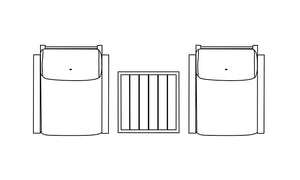
- Visual concept: Picture two chairs placed side by side against a wall with a small side table between them, or a compact loveseat positioned along the length of a narrow balcony with a side table at one end.
- Best conversation set types: This layout works best with 3-piece bistro sets featuring two chairs and a side table, or compact loveseat sets designed for small spaces. Swivel chairs add versatility, allowing occupants to turn and face each other.
- Furniture placement guide: Position all pieces with their backs against the wall or railing. Space chairs close enough for comfortable conversation, typically 24 to 36 inches apart. Center the arrangement on the wall or place it strategically near a focal point like a view or doorway.
- Side table versus coffee table: In linear layouts, a side table often works better than a coffee table. Placing a small table between two chairs allows both occupants easy reach without blocking the narrow walkway. A coffee table positioned in front of the seating may obstruct traffic flow.
- Advantages: This layout maximizes narrow spaces that cannot accommodate wider arrangements. It keeps walkways completely clear, essential for balconies and galley-style patios. The arrangement allows traffic to pass freely in front of the seating area.
- Limitations: Side-by-side seating limits face-to-face conversation since occupants sit parallel rather than facing each other. This layout suits quiet relaxation or watching a view better than active group conversation.
- Recommended sets: A 3-piece bistro set with swivel chairs provides ideal flexibility for narrow spaces. The swivel function allows occupants to turn toward each other for conversation, partially overcoming the parallel seating limitation.

What Are the Advantages of Each Conversation Area Layout Template?
Each layout template offers distinct benefits that address specific spatial challenges and usage preferences.
- Corner L-Shape Layout advantages: This arrangement excels at utilizing corner space efficiently, making it ideal for rectangular patios where corners often remain empty and wasted. The L-shaped configuration creates a defined conversation zone while maintaining an open center area that can serve multiple purposes, from walking paths to space for children to play. The asymmetrical arrangement adds visual interest and allows flexible placement of additional accessories like ottomans or planters in the open area.
- Centered Circle Layout advantages: The circular arrangement promotes democratic conversation where no single seat dominates the group. Every guest enjoys equal proximity to the center table and equal sightlines to other participants. This layout creates a cohesive, intentional look that immediately reads as a designed space rather than randomly placed furniture. The symmetrical balance provides visual harmony that calms the eye and makes the space feel larger than it is.
- Wall-Hugging Linear Layout advantages: This template delivers maximum walkway clearance, essential for narrow balconies and corridor-style patios where every inch of floor space matters. The against-the-wall positioning creates a clean, uncluttered appearance that makes small spaces feel more open. This layout also works perfectly for view-oriented patios where occupants want to face outward toward a garden, pool, or landscape rather than toward each other.
What Are the Disadvantages of Each Layout Template?
Understanding each template's limitations helps you choose the right option and mitigate potential drawbacks.
- Corner L-Shape Layout disadvantages: This arrangement requires access to a true corner bounded by two walls, fences, or visual boundaries. Patios that are completely open or bounded on only one side cannot effectively use this template. The L-shape also creates fixed positioning that reduces flexibility for rearranging furniture for different occasions. To mitigate this limitation, choose lightweight furniture pieces that can occasionally be moved, or select sets with modular components that allow reconfiguration.
- Centered Circle Layout disadvantages: This template demands a roughly square footprint with adequate clearance around all sides of the furniture grouping. Rectangular or narrow patios cannot accommodate the circular arrangement without pieces feeling cramped or blocking pathways. The layout also requires more total square footage than linear alternatives since furniture occupies the center rather than edges. If your space is slightly rectangular, consider positioning the circle arrangement at one end rather than centering it on the entire patio.
- Wall-Hugging Linear Layout disadvantages: The parallel seating position inherently limits face-to-face interaction since occupants sit side by side rather than facing each other. This arrangement works better for two people than for groups, as adding more seats simply extends the line further along the wall. Conversation requires turning your head to see the other person, which becomes uncomfortable over extended periods. Choosing swivel chairs substantially mitigates this disadvantage by allowing occupants to rotate and face each other as needed.
How Do You Choose the Right Conversation Set Size for Your Small Patio?
Selecting the appropriate piece count and dimensions requires matching your available space with your seating needs.
Determine Your Available Square Footage First
Before shopping for any furniture, return to your measurements. Calculate the usable square footage after subtracting clearance zones for walkways and door access. This net figure, not the gross patio size, determines what furniture will actually fit comfortably.
Match Piece Count to Patio Size
- 3-piece sets work best for spaces between 48 and 80 square feet. These sets typically include two chairs and a side table, or a small loveseat with a single chair and table. They provide seating for two people comfortably and occasional seating for three.
- 4-piece sets suit spaces between 80 and 120 square feet. These sets commonly feature a loveseat, two chairs, and a coffee table. They accommodate four people for conversation while maintaining adequate walkway clearance.
- 5-piece sets fit spaces between 100 and 150 square feet. These larger sets often include a sofa, two or three chairs, and a coffee table. They handle five seated guests while still leaving room for movement on a small to medium patio.
Consider Your Seating Needs
Think honestly about how you will use the space most frequently. If you primarily relax alone or with one other person, a 3-piece set provides ample seating without overcrowding. If you regularly entertain groups of three to four guests, invest in a 4-piece set that accommodates everyone comfortably.
Flexible configurations add versatility. Modular sets allow you to add or remove pieces based on the occasion. Ottomans that double as extra seating expand capacity when needed without permanent furniture commitment.
For small patios seeking quality and durability, explore the Chamber Collection conversation sets, which offer 3-piece, 4-piece, and 5-piece options with weather-resistant aluminum frames and Sunbrella fabric cushions.
How Should You Position an Outdoor Coffee Table in a Small Patio Conversation Area?
Proper coffee table placement maximizes functionality while maintaining clear pathways and comfortable reach for all seated guests.
- Centerpiece placement for circle layouts: In centered circle arrangements, position the coffee table at the exact center of the seating group. Maintain approximately 14 to 18 inches between the table edge and each seat cushion. This distance allows comfortable reach without requiring guests to lean far forward.
- Parallel placement for L-shape layouts: In corner L-shape arrangements, position the coffee table parallel to the loveseat at a similar 14 to 18-inch distance. The table should sit within easy reach of both the loveseat and the perpendicular chairs, typically at the intersection point of the L.
- Side table alternatives for linear layouts: In wall-hugging linear arrangements, a small side table placed between two chairs often works better than a coffee table positioned in front. This placement maintains clear walkway space while providing a surface for drinks and small items within arm's reach of both occupants.
- Distance guidelines: Regardless of layout, maintain 14 to 18 inches between seating and table edges. Closer placement restricts leg movement and makes standing difficult. Greater distance requires uncomfortable reaching to set down drinks or pick up items.
- Shape recommendations by layout: Round or oval coffee tables work best for circle layouts since they complement the curved seating arrangement and eliminate sharp corners in high-traffic areas. Rectangular tables suit L-shape layouts where they align with the loveseat. Compact square or round side tables serve linear layouts most effectively.
Browse outdoor coffee tables and side tables that complement your conversation set and patio layout.
What Are Expert Tips for Maximizing a Small Patio Conversation Area?
Design professionals recommend several strategies for making small outdoor spaces feel larger and more functional.
Use Vertical Elements to Expand Visual Space
Draw the eye upward to create the illusion of more space. Tall planters with vertical plants like ornamental grasses or bamboo add height without consuming floor area. Trellises with climbing vines provide greenery and privacy while occupying minimal footprint. String lights hung overhead define the ceiling plane and make the space feel more like a room.
Choose Light-Colored Cushions and Furniture Frames
Light colors reflect more light and recede visually, making spaces appear larger. Opt for neutral cushion colors like beige, cream, gray, or soft blue rather than dark tones that absorb light. Light-colored or natural-finish frames also contribute to an open, airy feeling.
Add an Outdoor Rug to Define the Conversation Zone
An outdoor rug anchors the seating arrangement and defines the conversation area as a distinct zone. Choose a rug size large enough for all furniture legs to rest on the rug, which visually unifies the grouping. The rug creates a sense of intentional design and makes the space feel more like an outdoor room.
Incorporate Multi-Functional Pieces
Every piece on a small patio should serve multiple purposes when possible. Ottomans that function as both footrests and extra seating maximize flexibility. Nesting tables stack when not needed and separate to provide multiple surfaces during gatherings. Storage benches hold cushions or outdoor accessories while providing seating.
Keep Pathways Clear (Minimum 24 Inches)
Maintaining clear pathways is non-negotiable on small patios. Blocked walkways make the entire space feel cramped and uncomfortable regardless of furniture quality. Measure pathways after furniture placement and adjust positions until you achieve at least 24 inches of clearance, preferably 30 to 36 inches for main traffic routes.

Conclusion
Creating the perfect conversation area on your small patio starts with understanding your space and choosing the layout template that matches your patio shape.
For rectangular patios, the Corner L-Shape Layout maximizes corner space while opening the center. For square patios, the Centered Circle Layout promotes equal conversation among all guests. For narrow patios and balconies, the Wall-Hugging Linear Layout keeps walkways clear while providing comfortable seating.
Always measure first, then select furniture. Calculate your usable square footage after subtracting clearance zones, and match your conversation set piece count to that net figure. A 3-piece set suits 48 to 80 square feet, a 4-piece set fits 80 to 120 square feet, and a 5-piece set works for 100 to 150 square feet.
Consider your primary use when choosing between options. Solo relaxation and intimate conversations require less seating than regular entertaining. Swivel chairs add flexibility that partially overcomes layout limitations.
Ready to transform your small patio into a welcoming conversation area? Explore the complete Patio Conversation Sets Collection to find the perfect fit for your space. For premium aluminum frames with Sunbrella cushions built to last, browse the Chamber Collection. Complete your layout with the ideal outdoor coffee table or side table to anchor your new conversation area.
FAQs
What is the minimum patio size for a 3-piece conversation set?
A 3-piece conversation set typically requires a minimum of 6 by 8 feet, or 48 square feet, for comfortable placement with adequate walking space. This allows room for two chairs and a side table plus a 24-inch walkway around the furniture.
Can I use an L-shaped layout on a balcony?
L-shaped layouts work best on patios with accessible corners bounded by two walls or railings. Most balconies feature one long wall and an open railing, making the Wall-Hugging Linear Layout more practical. However, if your balcony has a corner where it meets the building wall, an L-shape can work effectively.
Should the coffee table be round or rectangular for a small patio?
Round or oval coffee tables generally work better for small patios because they improve traffic flow and eliminate sharp corners in tight spaces. Round shapes also complement circular seating arrangements. Rectangular tables suit L-shaped layouts where they can align parallel to a loveseat.
How far should patio furniture be from the wall?
Leave at least 12 to 18 inches between furniture backs and walls. This clearance allows air circulation behind cushions, which prevents moisture buildup and mold. It also provides room for cleaning behind furniture and makes the arrangement feel less cramped.
What conversation set configuration is best for entertaining guests?
For entertaining 3 to 4 guests on a small patio, a 4-piece set with a loveseat, two chairs, and a coffee table arranged in a Corner L-Shape or Centered Circle layout offers the best face-to-face conversation potential. These configurations allow all guests to see each other easily and participate equally in conversation.
How do I maintain walkway clearance on a very small patio?
On very small patios, prioritize the Wall-Hugging Linear Layout to keep all walkway space open. Choose compact furniture pieces designed for small spaces. Consider a 3-piece bistro set rather than a larger conversation set. You can also use furniture with visible legs, which creates visual openness, rather than solid bases that block sightlines.
Related Articles

How to Choose the Right Coffee Table Height for...
Keeping a coffee table clean depends on its material. The best way to clean a coffee table is to match your cleaning method and products to the surface—whether it’s wood,...
How to Choose the Right Coffee Table Height for...
Keeping a coffee table clean depends on its material. The best way to clean a coffee table is to match your cleaning method and products to the surface—whether it’s wood,...
Continue Reading
Outdoor Furniture Maintenance Calendar: Your Co...
Introduction Did you know that regular cleaning and maintenance can reduce the risk of mold and mildew on patio furniture by up to 70%? Yet most homeowners struggle with the...
Outdoor Furniture Maintenance Calendar: Your Co...
Introduction Did you know that regular cleaning and maintenance can reduce the risk of mold and mildew on patio furniture by up to 70%? Yet most homeowners struggle with the...
Continue Reading
Outdoor Color Guide: Black vs White vs Woodgrai...
Finish color is the first visual variable that shapes an outdoor space. Before a single cushion is placed or a planter positioned, the frame color of patio furniture sets the...
Outdoor Color Guide: Black vs White vs Woodgrai...
Finish color is the first visual variable that shapes an outdoor space. Before a single cushion is placed or a planter positioned, the frame color of patio furniture sets the...
Continue Reading