







Outdoor Dining Layout Templates: Traffic Flow from 4 to 8 Seats

Most homeowners select outdoor dining furniture by appearance or price — then realize chairs cannot pull out without scraping the railing, or that carrying food from the grill means squeezing past seated guests.
The root cause is almost never the furniture. It is the layout. Traffic flow — the paths people use to sit, stand, serve, and walk behind chairs — dictates whether an outdoor dining area feels generous or claustrophobic.
Planning circulation routes before choosing any outdoor dining set avoids expensive returns. A practical starting point is the painter's tape test: mark the intended table and chair footprint on the patio with tape, then walk every path at full stride.
Why Does Traffic Flow Matter More Than Table Style in an Outdoor Dining Layout?
Traffic flow determines whether guests can sit, stand, serve, and pass behind chairs without collisions. A striking table in the wrong position blocks movement and shrinks usable space. Planning circulation paths first — then selecting furniture — prevents costly rearrangements and cramped dining experiences.
How Does Table Shape Change the Traffic Pattern on a Patio?
Round tables allow 360-degree circulation with no corner pinch points, making them ideal for square patios and four to six seats. Rectangular tables scale from four to eight seats by adding length and create parallel service lanes, but require wider patios to avoid end-seat bottlenecks.
When Is a Round Table the Best Choice for Patio Flow?
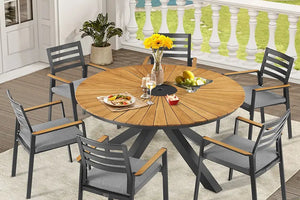
A round dining table gives every diner equal sightlines and eliminates the "bad seat." Guests pass uniformly around the perimeter, which suits square or irregular patios well. The limitation appears at eight seats: a round table large enough exceeds 60 inches in diameter, straining conversation across that distance.
When Does a Rectangular Table Outperform a Round One?
Rectangular tables are the most scalable shape — adding length accommodates more chairs without increasing width. The two long sides become natural parallel traffic lanes. Pairing a bench on one side against a wall removes push-back requirements entirely — ideal for narrow decks and 6–8 diners.
What Advantage Do Oval or Rounded-Edge Tables Offer?
Oval tables combine the social intimacy of round with the scalability of rectangular. Their smooth ends eliminate corner pinch points where end-seat diners feel trapped. Even a standard rectangular table with slightly rounded corners adds a few extra inches of passable space at each end. Peakhome's round vs. rectangular guide covers these trade-offs in detail.
What Is the Right Layout for a 4-Seat Outdoor Dining Setup?
A four-seat layout fits within a minimum of 8 × 8 feet for a freestanding round table — using functional push-back clearance — or as little as 6 × 9 feet when one side sits against a wall. For the full 36-inch recommended clearance on all sides, plan for 10 × 10 feet. Traffic flow is simple at this count — the key decision is how many table sides remain accessible.
Template A — Round Table, Open Patio (8 × 8 ft)
A 42–48-inch round table centered with 36-inch clearance on all sides is the most versatile four-seat arrangement. Traffic circles the full perimeter, and no seat is harder to reach than another. Best for open, freestanding setups.
Template B — Square Table, Corner Placement (7 × 7 ft)
A 36–42-inch square table pushed into a 90-degree corner seals two sides against walls and opens the remaining two for seating, cutting the required footprint by roughly 25 percent. Best for small balconies and narrow side patios. Homeowners with especially compact spaces may consider a bistro set.
Template C — Rectangular 4-Top, Wall-Side (6 × 9 ft)
A 48–60-inch table with one long side against a wall places two seats on the open long side and one at each short end. The service path runs along the open side. Best for galley-style patios and poolside dining nooks.
How Should Six Seats Be Arranged to Keep Service Paths Clear?
Six seats mark the transition where layout choice significantly impacts flow. A freestanding rectangular table fits a minimum of 10 × 10 feet with functional push-back, though 12 × 12 feet is recommended for full clearance on all sides. A bench-and-chair hybrid against a wall cuts the minimum to 8 × 10 feet.
Template A — Freestanding Rectangular Table (10 × 10 ft)
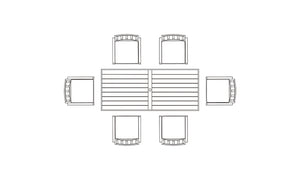
A 60–72-inch table with two chairs per long side and one at each end works well when the kitchen-facing side receives 44-inch-plus clearance as the primary service lane. Linear serving flow runs along the long axis.
Template B — Round Table, Center Patio (10 × 10 ft)
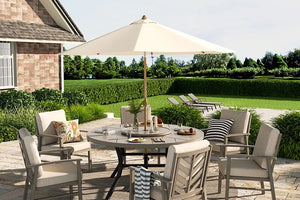
A 54–60-inch round table distributes six chairs evenly around a uniform clearance ring with no single bottleneck. Swivel dining chairs enhance this configuration — diners rotate in place rather than dragging chairs backward.
Template C — Bench + Chairs Hybrid Against a Wall (8 × 10 ft)
A 72-inch table with an outdoor bench on the wall side and three individual chairs opposite eliminates all push-back on the bench side — the biggest single space saver at six seats. All traffic concentrates on the chair side, where 44-inch-plus clearance should be maintained.
What Layout Works Best for 8 Diners Without Blocking Movement?
Eight seats demand a dedicated dining zone of at least 12 × 12 feet at functional minimums, with 14 × 14 feet recommended for full clearance. Rectangular and oval tables dominate because they create dual service lanes. The critical rule: 48 inches on the kitchen-facing side, 42 inches or more at both ends.
Template A — Rectangular Table, Full Access (12 × 12 ft)
An 80–96-inch rectangular table like the Tampa dining set seats three per long side with one at each end. End seats are the tightest — swivel chairs reduce obstruction.

Shop the look: Tampa 9 Piece Outdoor Dining Set
Template B — Oval Table Under a Pergola (11 × 12 ft)
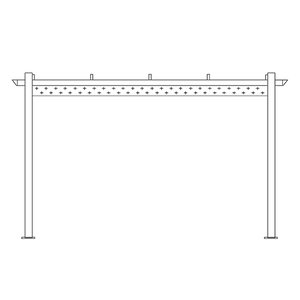
An 84–96-inch oval table achieves a slightly more compact footprint, with rounded ends improving flow at the short axis. Aligning the long axis with a pergola provides even shade coverage.
Template C — Two Square Tables for Flexible Hosting (10 × 14 ft)
Two 42-inch square tables end-to-end create a banquet surface that splits into independent four-tops when the guest count drops. A natural midpoint gap provides an extra service access point.
Why Does the 8-Seat Layout Fail Without a Defined Service Lane?
At eight seats, the host carrying food is the highest-traffic element. Without a 44–48-inch lane, that person weaves between chairs and spill risk climbs. The grill-to-table axis must connect to the service-lane side in a straight line, with four feet of clearance in front of the grill.
How Do Swivel Chairs and Chair Types Affect Push-Back Clearance?
Swivel chairs reduce push-back by 6–10 inches per seat because diners rotate to exit. Over eight seats, this recovers up to 80 inches of clearance — often the difference between a functional layout and a failed one.
How Much Space Does a Swivel Chair Save vs. a Fixed Chair?
A fixed chair needs the full 36-inch push-back. A swivel chair needs only 26–30 inches. At eight seats with four per long side, that recovers 24–40 inches of floor space along each side.

Shop the look: Tamarin 2-Piece Outdoor Dining Swivel Chair
Armchair vs. Armless — Which Fits More Seats?
Armchairs require 26–28 inches per seat; armless chairs need only 22–24 inches, allowing one extra seat per 72-inch table side. A practical rule: armchairs at table ends for elbow room, armless along the sides for density.
How Should a Fire Pit Table Be Positioned to Maintain Dining Flow?
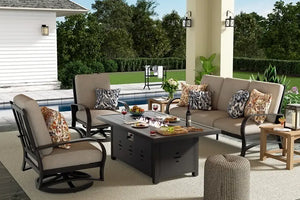
A fire pit dining table requires 18–24 inches between the flame edge and the nearest seat front, plus the standard 36-inch push-back behind each chair. Round fire pit tables create natural conversation-circle flow; rectangular ones follow standard templates with added safety clearance.
What Are the Spacing Rules for Fire Pit Dining?
Beyond the 18–24-inch flame-to-seat buffer, no umbrella canopy or pergola fabric should be positioned directly above the flame, and all combustible shade structures should remain at least ten feet away. Most safety guidelines also recommend the table sit at least ten feet from any permanent structure — though local building codes vary.
How Does One Separate a Dining Zone from a Lounge Area?
Waist-high planters, outdoor rugs, or a one-step elevation change create a visual boundary that redirects traffic around the dining zone. The rug should extend at least 24 inches beyond chair push-back on all seated sides.
What Works as a Zone Divider Without Blocking Sightlines?
Planters at waist height signal a zone edge while preserving views. Rugs frame the dining footprint on the ground plane. A bar table or serving station at the perimeter functions as both divider and staging surface.
How Close Can Poolside Loungers Be to the Dining Zone?
A practical guideline is to keep at least six feet between the dining push-back zone and the pool edge for safe, unobstructed passage. Keep chaise lounges on the far side of that buffer. Traffic should never route between the dining area and the water.
Should Dining Go on the Upper or Lower Level of a Multi-Tier Deck?
Upper tier placement shortens the serving distance from the kitchen and eliminates stair trips with loaded plates. Each tier needs a minimum of four feet of depth for furniture and circulation.
What Are the Most Common Outdoor Dining Layout Mistakes?
The most frequent errors are underestimating chair push-back distance, blocking the door-to-table path, ignoring the grill-to-table axis, and cramming eight chairs around a six-person table. A four-inch miscalculation per chair across eight seats can reduce the service lane below usable width.
Why Does Centering the Table Cause Problems on Single-Entry Patios?
It forces all foot traffic through the dining zone. The fix: offset the table to create a bypass lane along one edge.
What Happens When the Grill-to-Table Axis Is Ignored?
The cook carrying hot food takes the longest, most obstructed path. The table's service-path side should face the grill in a straight line, with four feet of clearance in front of the cooking station.
How Does the Umbrella Base Footprint Ruin a Layout?
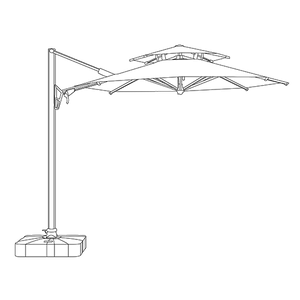
A center-pole base occupies 24–30 inches and can block a chair position. Cantilever patio umbrellas shift the base outside the dining footprint. Peakhome's buying mistakes guide covers additional pitfalls.
What Quick-Reference Measurements Should Every Homeowner Save?
Save these numbers: 36 inches minimum behind every chair, 44–48 inches for serving paths, 24–30 inches of table edge per person, and 48 inches in front of any grill. A four-seat layout starts at 8 × 8 feet; an eight-seat layout requires at least 12 × 12 feet.
Seat-Count Spacing Cheat Sheet:
|
Seats |
Round Table Ø |
Rectangular Table |
Min. Layout |
Comfort Layout |
|
4 |
42–48 in. |
48 × 36 in. |
8 × 8 ft |
10 × 10 ft |
|
6 |
54–60 in. |
72 × 36 in. |
10 × 10 ft |
12 × 12 ft |
|
8 |
60–72 in. |
84–96 × 40 in. |
12 × 12 ft |
14 × 14 ft |
Universal Clearance Rules at a Glance:
- Behind chairs (minimum): 36 in. | Serving side: 44–48 in.
- Table edge to wall (no seating): 12–18 in.
- In front of the grill: 48 in.
- Fire pit flame to nearest seat: 18–24 in.
- Pool edge to push-back zone: 6 ft
- Door swing arc: always fully clear
FAQs
Are round or rectangular tables better for small patios?
Round tables work better on square or irregular patios — 360-degree circulation eliminates corner pinch points, and a 48-inch round table fits four within 8 × 8 feet. Rectangular tables outperform on narrow decks by aligning with the long axis. The deciding factor is patio shape, not personal preference.
Do swivel chairs really make a difference in tight layouts?
Yes. Each swivel chair saves 6–10 inches of push-back because the diner rotates instead of pulling backward. Across eight seats, this recovers 24–40 inches per table side — often enough to convert a non-functional layout into a comfortable one.
Can a fire pit table replace a standard dining table?
It can, but spacing requirements increase. The flame edge must sit 18–24 inches from the nearest seat, and no overhead canopy should be within ten feet. Guests linger significantly longer, so a well-defined service path becomes even more essential.
What is the single most common layout mistake?
Underestimating chair push-back distance. Most homeowners measure only the table and forget that each occupied chair extends 18–24 inches behind the table edge. The painter's tape test — marking full chair positions before buying — eliminates this error completely.
Related Articles

Cozy Porch Chair: How To Choose And Arrange For...
A cozy porch chair can turn a simple porch into a comfortable retreat that invites relaxation any time of day. It balances comfort, style, and durability while matching the size...
Cozy Porch Chair: How To Choose And Arrange For...
A cozy porch chair can turn a simple porch into a comfortable retreat that invites relaxation any time of day. It balances comfort, style, and durability while matching the size...
Continue Reading
Pool Furniture Layout Ideas for a Stylish and F...
Pool furniture layout ideas define how an outdoor space functions and feels, given that placement controls circulation, comfort, and safety around the water. A strong layout balances clear walkways, activity zones,...
Pool Furniture Layout Ideas for a Stylish and F...
Pool furniture layout ideas define how an outdoor space functions and feels, given that placement controls circulation, comfort, and safety around the water. A strong layout balances clear walkways, activity zones,...
Continue Reading
Difference Between vs. Gazebo vs. Pavilion: Ke...
Outdoor shade structures can look pretty similar at first glance, which makes choosing one a bit tricky. You’ll see pergolas, gazebos, and pavilions in a lot of backyards, but they’re...
Difference Between vs. Gazebo vs. Pavilion: Ke...
Outdoor shade structures can look pretty similar at first glance, which makes choosing one a bit tricky. You’ll see pergolas, gazebos, and pavilions in a lot of backyards, but they’re...
Continue Reading