






Umbrella Sizing: How to Shade 42″–54″ Tables

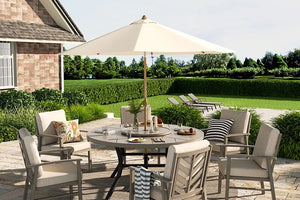
A stunning patio dining set deserves shade that actually covers every seat. Too often, homeowners invest in a quality outdoor table only to pair it with an umbrella that leaves half the party squinting in the afternoon sun.
For anyone furnishing a space around a 42- to 54-inch table, getting the canopy size right is the single decision that separates a comfortable outdoor dining experience from a frustrating one.
This guide walks through the exact sizing logic, shape matching, hardware compatibility, and common pitfalls so that every guest stays cool from the first course to the last.
What Size Umbrella Does a 42″–54″ Patio Table Need?
The table shows the recommended umbrella size for 42″–54″ patio table:
|
Table Diameter |
Recommended Umbrella Size |
Seating Capacity |
Minimum Overhang Per Side |
|
42″ |
7.5–9 ft |
4 persons |
2 ft |
|
48″ |
9 ft |
4–6 persons |
2 ft |
|
54″ |
9–11 ft |
6 persons |
2 ft |
The canopy should extend at least 2 feet beyond the table edge on every side to shade seated guests comfortably. For tables between these sizes, round up to the next umbrella increment.
The industry-standard sizing principle is straightforward: add roughly four to five feet to the table's diameter.
Those extra feet account for the space diners actually occupy once chairs are pushed back 18 to 24 inches from the table edge. A person sitting at a 48-inch round patio dining table is not sitting at the table rim — the body and chair together extend the shaded zone that matters.
How Does the 2-Foot Overhang Rule Work?
The math is simple. Take the table diameter in inches, add 48 inches (24 inches per side), then convert to feet. A 42-inch table plus 48 inches equals 90 inches, or 7.5 feet — the minimum umbrella diameter. A 48-inch table reaches 96 inches, making a 9-foot canopy the natural choice. A 54-inch table comes to 102 inches, which means a 9-foot umbrella technically works but sits right at the margin; a 10- or 11-foot canopy provides noticeably more breathing room.
How Does Seat Count Simplify the Decision?
For homeowners who prefer a quicker method, seat count serves as a reliable proxy. Four seats typically correspond to a 42- to 48-inch table and pair with a 7.5- to 9-foot umbrella. Four to six seats — common around a standard patio dining set — match a 9-foot canopy. Six or more seats call for 9 to 11 feet. This shortcut reaches the same conclusion as the overhang formula without requiring a tape measure.
How Much Shade Does Each Umbrella Size Actually Provide?
A 7.5-foot umbrella covers roughly 44 square feet. A 9-foot canopy shades approximately 55 to 63 square feet. A 10-foot umbrella reaches about 78 square feet, and an 11-foot model covers approximately 95 square feet. Larger canopies deliver disproportionately more coverage per added foot.
Diameter is a linear measurement, but shade is an area calculation — and area grows with the square of the radius. Jumping from a 9-foot to a 10-foot umbrella adds only one foot of diameter but increases the shaded zone by roughly 40 percent. That jump is often the strongest argument for sizing up, especially for households that entertain frequently around a 54-inch table.
Why Does Rib Count Affect Real-World Coverage?
Not all 9-foot patio umbrellas perform the same. A canopy stretched across eight ribs holds tighter tension and tracks closer to its advertised diameter. A six-rib frame allows more fabric sag between panels, effectively reducing the usable shade footprint by 10 to 15 percent. When comparing two umbrellas of the same stated size, rib count is one of the easiest ways to predict which one delivers more consistent coverage.
How Does the Sun's Position Change Effective Coverage?
At noon the shadow falls almost directly beneath the canopy, closely matching its full diameter. By mid-afternoon the sun drops lower, stretching and shifting the shadow — an umbrella that seemed perfectly sized at lunchtime may leave one side of the table fully exposed by four o'clock. A tilt mechanism compensates for this shift, extending effective coverage by roughly 15 to 20 percent. Homeowners with west-facing patios that absorb intense afternoon sun should consider either an auto-tilt feature or stepping up one size. For spaces where sun tracks across the entire day, a permanent structure such as a retractable pergola or hardtop gazebo may be a more practical complement.
Which Umbrella Shape Works Best for Round, Square, and Rectangular Tables?
Matching canopy shape to table shape is the fastest way to ensure even shade distribution:
- Round umbrellas pair naturally with round tables up to 54 inches.
- Square canopies suit square tables by matching edge geometry.
- Rectangular tables wider than 42 inches need a rectangular or offset canopy to cover both ends, since a round umbrella leaves the long sides exposed.
Shape is not purely aesthetic — it determines how evenly shade distributes across the seating area. A 48-inch square table has a diagonal of 68 inches, meaning the corners extend well beyond what the table's nominal width suggests. A round umbrella covers the center efficiently but may miss the corner seats; a square canopy of the same stated size eliminates that gap.
Rectangular and oval tables in the 42- to 54-inch width range present a different challenge. Their length often exceeds their width by 30 inches or more, and a round canopy simply cannot stretch to shade both ends. The solution is a rectangular umbrella whose length exceeds the table by at least 24 inches, or an offset cantilever positioned to cast an elongated shadow.
Should Homeowners Pick a Market Umbrella or a Cantilever?
A center-pole market umbrella is the better choice for 42″–54″ tables with a built-in umbrella hole. It offers greater wind stability and a lower price point. A cantilever works better when the table has no center hole or when the goal is to shade a fire pit or conversation set instead.
For the vast majority of 42- to 54-inch patio dining sets, a market umbrella with a crank-and-tilt mechanism covers every practical need. The Patio Tree 11ft Octagon Market Umbrella with Sunbrella® Fabric, available at Peak Home Furnishings, pairs well with 54-inch and larger round tables that need generous overhead coverage.

Shop the look: Patio Tree 11ft Octagon Market Umbrella with Sunbrella® Fabric
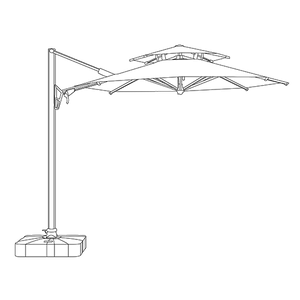
Cantilever outdoor umbrellas earn their premium when the table lacks a center hole or when the shaded area is a fire pit table set or patio conversation set where a center pole would obstruct the sightline. The Patio Tree Milano 10ft Square Cantilever Umbrella, offered by Peak Home Furnishings, features a double-top vented canopy suited to open lounge areas and poolside setups.

Shop the look: PATIO TREE Belize 11ft Large Round Patio Cantilever Umbrella For Garden Pool Porch
What Pole Height and Diameter Are Needed for 42″–54″ Tables?
Standard dining tables need a pole height of at least 7.5 feet for comfortable headroom. Pole diameters range from 1.5 to 2.5 inches and must match the table's umbrella hole within a quarter inch. Bar-height 42-inch tables require a 45-inch bottom pole section instead of the standard length.
Pole-to-hole fit is a detail many buyers overlook until the umbrella arrives and wobbles in the wind. The umbrella hole opening should be no more than a quarter inch larger than the pole diameter. A gap much wider than that creates lateral play that compounds with every gust.
Do Bar-Height 42″ Tables Need a Special Pole?
Yes. A standard umbrella's bottom pole section measures typically from 30 to 36 inches — fine for a dining table at 29 to 30 inches, but too short for a bar-height table that stands around 42 inches tall. The fix is a 45-inch bottom pole or a pole extender, both of which restore the 7-plus feet of clearance guests need to stand and move around outdoor bar stools comfortably.
How Is an Existing Umbrella Measured for Replacement?
Open the umbrella fully, then measure from the center hub to the tip of one rib. Double that number to get the canopy diameter. Rib length can vary by several inches between manufacturers even within the same stated size category, so measuring the actual span is more reliable than relying on the original product listing.
How Heavy Should the Umbrella Base Be?
A 7.5- to 8-foot umbrella needs a 40- to 60-pound base. A 9-foot canopy requires 50 to 65 pounds. A 10-foot umbrella needs 65 to 75 pounds. Because the table itself adds roughly 15 to 20 pounds of effective anchoring, freestanding setups need heavier bases than through-table installations.
|
Umbrella Size |
Through-Table Base |
Freestanding Base |
|
7.5′–8′ |
30–40 lb |
40–60 lb |
|
9′ |
40–50 lb |
50–65 lb |
|
10′ |
50–65 lb |
65–75 lb |
|
11′+ |
65–75 lb |
75+ lb |
Sand-filled bases provide the most stable anchoring weight and will not evaporate or freeze. Water-filled bases are lighter and more portable but risk cracking in winter climates if not drained. Weighted metal plates offer the strongest hold and the most compact footprint but cost more. For a 9-foot umbrella through a 48-inch outdoor dining table in a moderately windy area, a 50-pound sand-filled base strikes the best balance of stability, price, and convenience.
What Fabric and UV Rating Should Buyers Look For?
Solution-dyed acrylic fabric such as Sunbrella resists fading, mildew, and water while blocking over 98 percent of UV rays. Polyester costs less but degrades faster in sustained sunlight. A UPF 50-plus rating is the minimum standard for meaningful sun protection on any umbrella intended for daily outdoor use.
Fabric density affects more than longevity — it determines whether shade feels genuinely cool or merely dim. Tightly woven canopies with a built-in ventilation panel allow heat to escape upward rather than trapping it beneath the umbrella. The same umbrella fabric also provides light rain resistance, making it a practical shield during brief afternoon showers — though it is not a substitute for a solid roof in heavy storms.
What Are the Most Common Umbrella Sizing Mistakes?
The most frequent error is measuring only the tabletop while ignoring chair depth, which leads to an undersized canopy. Other common mistakes include skipping the base weight calculation, mismatching pole diameter to the table hole, and choosing a massive cantilever for a small bistro table.
Measuring the tabletop alone and forgetting that diners push patio dining chairs back 18 to 24 inches is the single most common reason people end up with inadequate shade.
The second most costly mistake is ignoring base weight: an umbrella that catches wind without sufficient anchoring becomes a tipping hazard rather than a comfort feature.
Third, pole-to-hole mismatch creates a wobble that worsens with every gust and can scratch or chip a table's finish over time.
Fourth, placing an oversized cantilever over a compact 42-inch bistro table creates unnecessary wind load and visual imbalance.
Fifth, assuming all 9-foot umbrellas are identical overlooks real differences in rib count, canopy venting, and fabric quality that change actual performance.
Finally, using a standard-length pole on a bar-height table results in inadequate headroom and an awkward, cramped setup.
FAQs
What size umbrella for a 42-inch round table?
A 7.5- to 9-foot umbrella. The 9-foot option is preferable for south-facing patios or setups without a tilt mechanism.
Is a 9-foot umbrella too big for a 42-inch table?
No. A 9-foot canopy extends roughly 2.5 feet past each edge of a 42-inch table, which comfortably shades all four chairs and provides a buffer for afternoon sun angles.
What size umbrella for a 48-inch table?
A 9-foot umbrella is the standard recommendation and the most popular residential patio umbrella size for this table diameter.
Can a cantilever umbrella go through a table's center hole?
It is not recommended. Doing so defeats the cantilever's core advantage — flexible positioning with no center-pole obstruction — and creates closing and storage issues.
How heavy should the base be for a 9-foot umbrella?
Between 50 and 65 pounds for a freestanding setup, or 40 to 50 pounds when the umbrella passes through a table that adds its own anchoring weight.
Do bar-height 42-inch tables need a different umbrella?
They need a taller pole. Standard bottom pole sections are roughly 33 inches; bar tables require a 45-inch section or a pole extender to maintain safe headroom above standing guests.
Related Articles

Collection Spotlight: Who Is the Chamber Collec...
Not every outdoor furniture collection is meant for every backyard. The Chamber Collection — Peakhome's bestselling line — earns that status not by appealing to everyone, but by solving a...
Collection Spotlight: Who Is the Chamber Collec...
Not every outdoor furniture collection is meant for every backyard. The Chamber Collection — Peakhome's bestselling line — earns that status not by appealing to everyone, but by solving a...
Continue Reading
Make Outdoor Cushions Last Longer: Removable Co...
Outdoor cushions take the hardest beating of any patio furniture component. While aluminum frames and HDPE rattan resist years of weather exposure, the cushions sitting on top of them face...
Make Outdoor Cushions Last Longer: Removable Co...
Outdoor cushions take the hardest beating of any patio furniture component. While aluminum frames and HDPE rattan resist years of weather exposure, the cushions sitting on top of them face...
Continue Reading
What Is a Quick-Dry Foam/Seat Board? Best for R...
A homeowner invests in a gorgeous outdoor sofa set, arranges it beside the pool, and then one thunderstorm turns the cushions into soggy sponges that take two days to dry...
What Is a Quick-Dry Foam/Seat Board? Best for R...
A homeowner invests in a gorgeous outdoor sofa set, arranges it beside the pool, and then one thunderstorm turns the cushions into soggy sponges that take two days to dry...
Continue Reading